
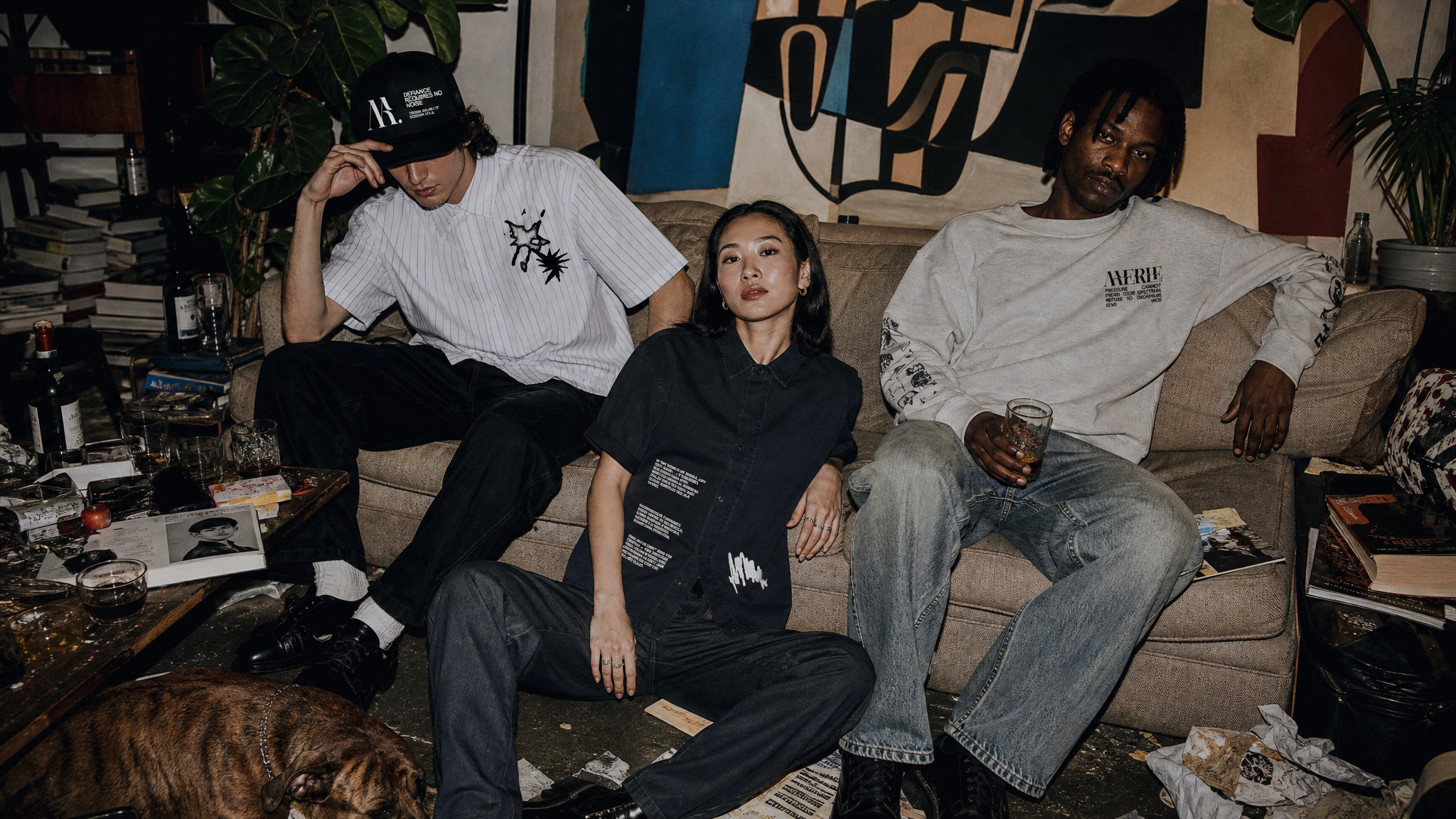
There is a certain way a song changes a scene.
The camera moves.
The streetlight flickers.
A bassline enters through the cracked window of a parked car, and suddenly the jacket, the jewelry, the denim, the whole silhouette means something else.
This is where Scorsese meets Memphis.
Not as a literal collaboration. As a shared language.
One speaks through needle drops, violence, memory, and the hum of the city. The other speaks through 808s, warped tapes, dark rooms, and regional code. Both understand that sound does more than accompany an image.
Sound gives the image a past.
Sound gives the image intent.
And eventually, sound enters the wardrobe.
The Needle Drop Becomes a Dress Code
Martin Scorsese treats music like architecture.
His songs do not sit quietly beneath the action. They push the story forward. They interrupt it. They expose the contradiction inside a character.
In Goodfellas, “Layla” does not simply create atmosphere. Its mournful piano and slide guitar turn a sequence of bodies, cars, and discarded evidence into something almost sacred. In Mean Streets, “Be My Baby” opens the film with a rush of drums and girl-group drama. The street becomes romantic, dangerous, cinematic.
According to Rolling Stone’s guide to Scorsese’s soundtracks, the director repeatedly reaches for the music people hear in the street: doo-wop, blues, soul, rock, punk, and vintage R&B.
That choice matters.
The soundtrack feels lived in. It feels borrowed from somebody’s car stereo, somebody’s record collection, somebody’s late-night walk home.
The same thing happens with clothing.
A garment can feel like background noise. Or it can change the entire scene.
A washed black tee. A loose pair of denim. A button-up with one deliberate disruption. The clothes do not explain themselves. They establish the world before you say a word.
The right song does not decorate the scene. It reveals the scene.
Memphis Rap Does Not Polish the Signal
Memphis rap comes from a different frequency.
The genre develops in Memphis during the mid-to-late 1980s and carries a distinct low-budget, distorted, hypnotic sound. Heavy 808s. Minimal synths. Repetitive hooks. Sharp snares. Dark samples. Bedroom studios pushed past their limits.
The roughness is not a flaw.
It is the signature.
As Memphis rap’s documented history and characteristics show, the scene grows through independent labels, local networks, club culture, and cassette circulation. It does not wait for approval from New York or Los Angeles. It builds its own distribution system.
That spirit travels into fashion.
Not through a clean translation. Through texture.
A faded graphic. A heavy cotton body. A raw hem. A silhouette that feels slightly oversized, slightly lived-in, slightly outside the approved frame.
Memphis rap understands the power of repetition. A hook returns until it becomes a ritual. Streetwear does something similar. A symbol appears on the chest, the sleeve, the back. You wear it enough times and it stops being decoration.
It becomes part of your personal mythology.
Hustle & Flow Makes the Studio a Film Set
If Scorsese shows how music can control a scene, Hustle & Flow shows what happens when the scene is built around making music.
Craig Brewer’s 2005 film follows DJay, a Memphis hustler who begins recording rap from the spaces around him. The story is not set inside some polished creative campus. It grows through cramped rooms, improvised equipment, tired bodies, arguments, ambition, and the pressure of trying to make something real.
The film’s soundtrack centers Southern hip-hop and Memphis music culture. Three 6 Mafia’s “It’s Hard out Here for a Pimp” wins the Academy Award for Best Original Song, marking a major crossover moment for a sound that comes from the underground.
But the deeper impact is visual.
The film makes creation look physical.
The microphone sits in the room. The beat leaks through the walls. The people around the song become part of the song. Every object carries friction.
That is the same energy behind the MERLE Frequency Log T-Shirt. The washed olive heavyweight tee uses analog static distortion, archive-style metadata, and a recovered-artifact feeling. It looks like something pulled from a damaged transmission.
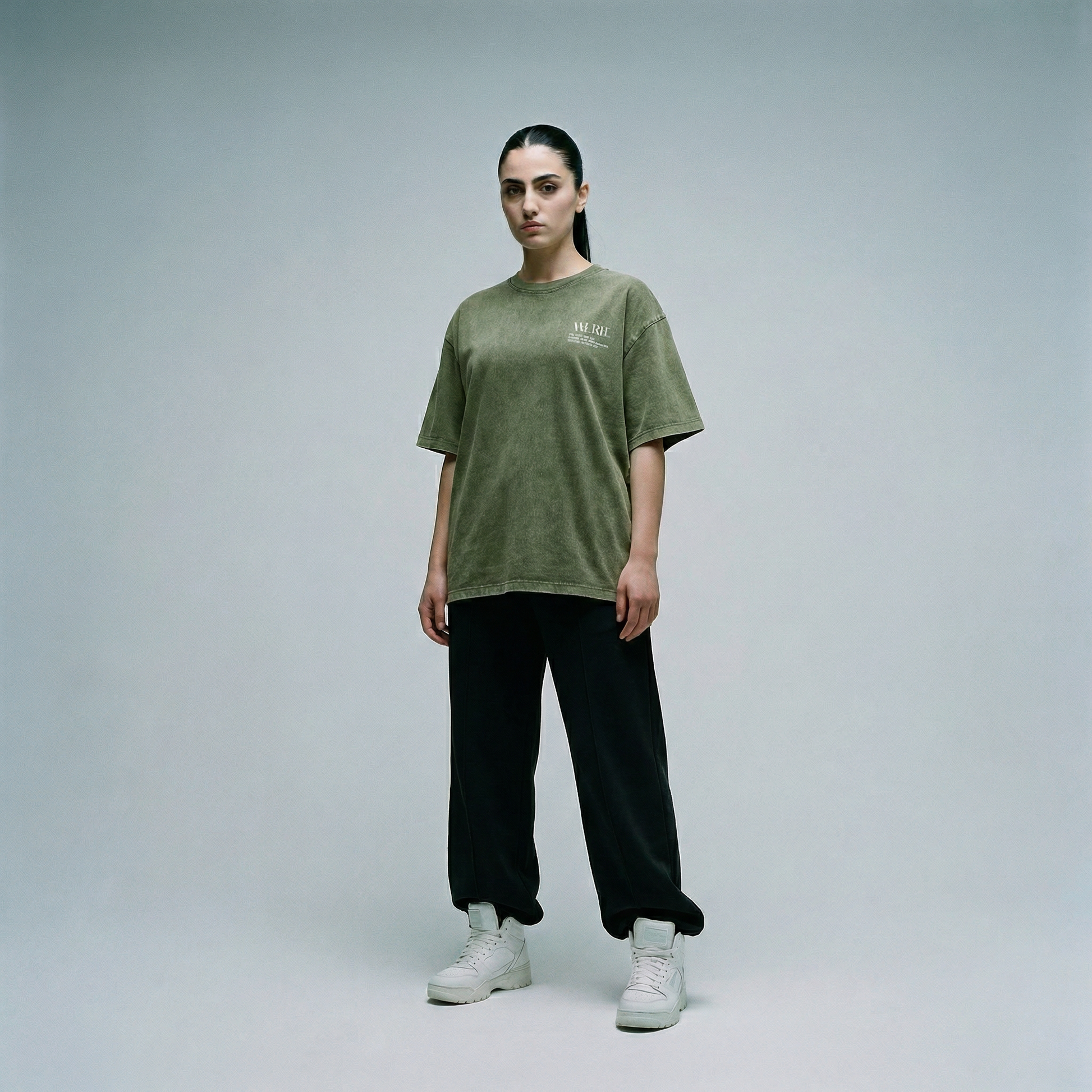
It feels less like a logo and more like evidence.
That distinction matters.
The best streetwear does not make you look like an advertisement. It makes you look like you belong to a story that started before the camera arrived.
Film References Become Personal Uniforms
Hip-hop has always understood cinema as a source of symbols.
Gangsters. Antiheroes. Getaway drivers. Lone figures under sodium streetlights. Men in suits who look calm while everything collapses around them.
Scorsese becomes shorthand for cinematic tension. His films give rappers a visual vocabulary for power, paranoia, loyalty, betrayal, excess, and collapse.
The references move quickly.
A lyric becomes a video. The video becomes an image. The image becomes a graphic. The graphic becomes a tee. The tee enters the street and starts carrying a new meaning.
This is why film-inspired fashion works when it is subtle.
A direct movie still can be obvious. A silhouette, a color palette, a texture, or a cut can be more effective. You do not need to wear the entire reference. You need to let it haunt the outfit.
Try building a look like a scene:
- Start with a muted base.
- Add one garment with visual disruption.
- Keep the proportions loose enough to move.
- Let texture carry the drama.
- Finish with one object that feels found, not styled.
The MERLE Distortion Striped Button-Up works inside that tension. It takes a familiar form and interrupts it with a deliberate mark of energy. Clean lines meet disruption. Order breaks just enough to become interesting.
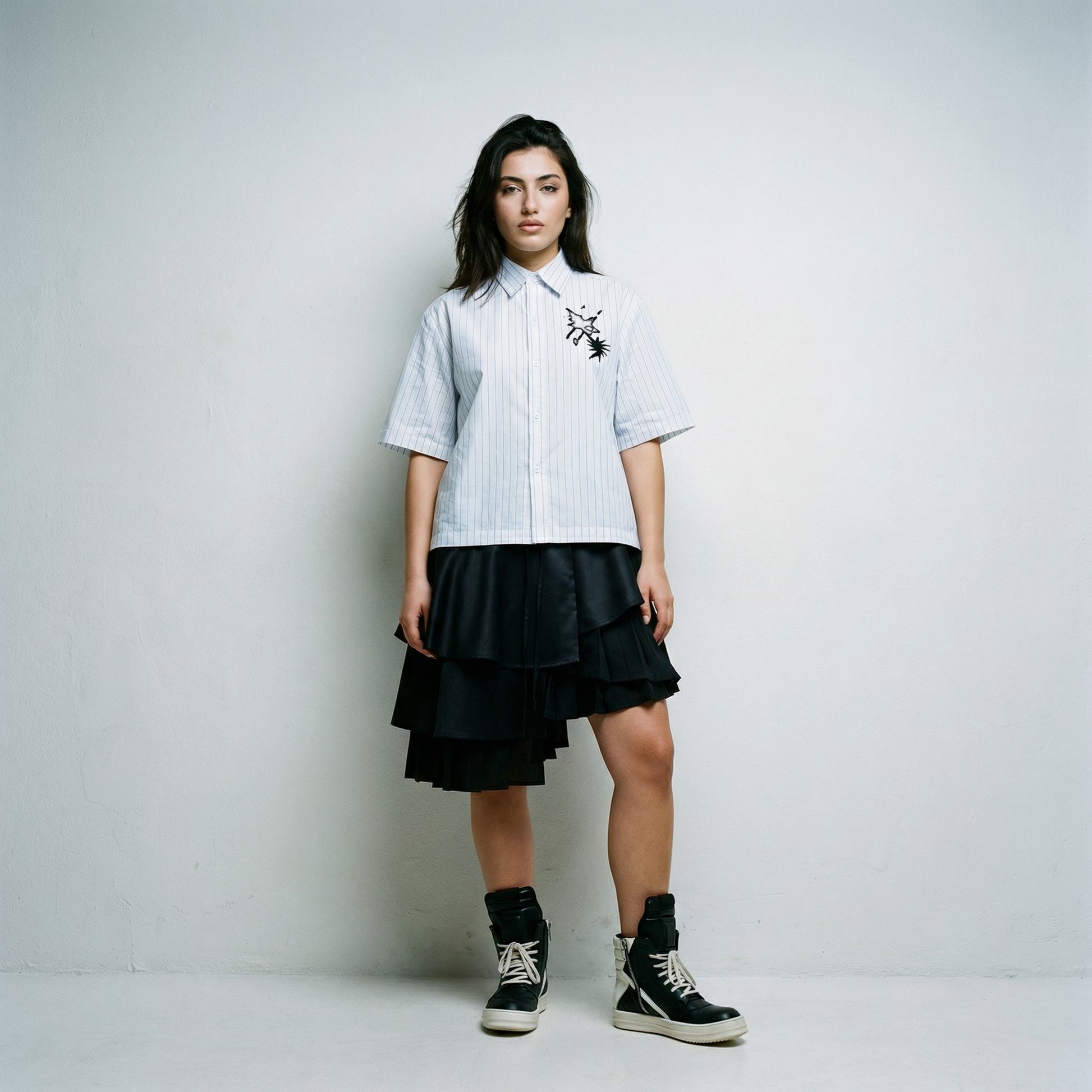
It is controlled rebellion.
Not costume.
Not cosplay.
A uniform for the person who notices the frame.
Dress for Motion, Not Performance
The chase scene is one of cinema’s oldest visual languages.
Someone runs through an alley. A car cuts across an intersection. The camera shakes. The coat catches air. The soundtrack speeds up, or slows down, or disappears entirely.
The body tells the story first.
Streetwear inherits that logic. The clothes need to move through real environments. Trains. Sidewalks. Basements. Studios. Record stores. After-hours diners. Unplanned detours.
This is where the MERLE Pressure Field Jeans make sense. Loose structure. Vintage wash. Heavy denim. Raw graphic fragments. They are built around movement, pressure, and clarity.
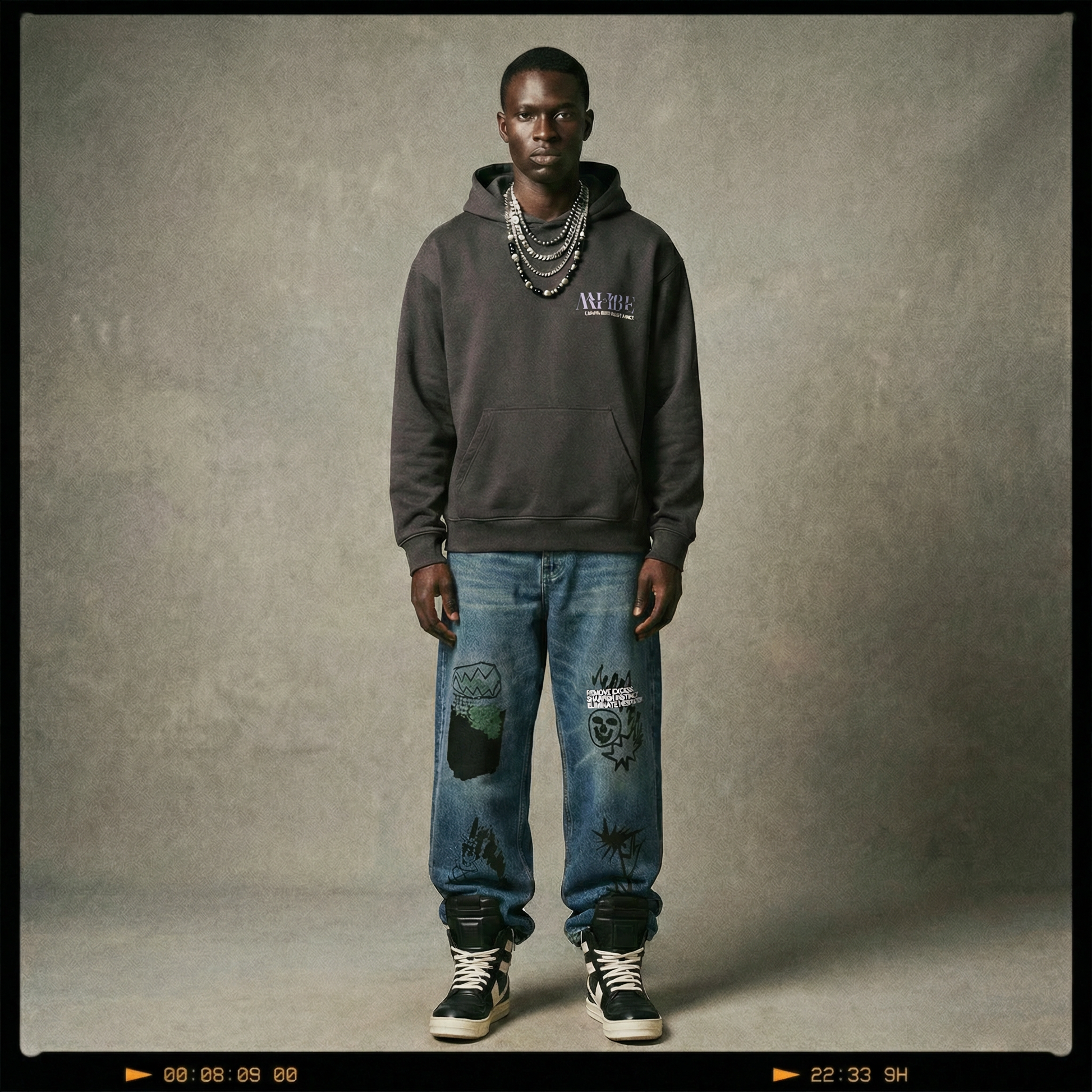
The fit gives the body room.
The weight gives the garment presence.
The wash makes it feel like it has already traveled somewhere.
That is the difference between dressing for attention and dressing for motion. One asks to be seen. The other is ready to leave.
The strongest outfit is not waiting for its close-up.
Chicago Watches Memphis Through the Screen
MERLE comes from Chicago.
Memphis is not Chicago. The cities carry different histories, different weather, different rhythms, different forms of pressure.
That distance is important.
The point is not to flatten regional cultures into one moodboard. The point is to recognize the underground connection: independent production, local language, limited resources, self-defined style, and the refusal to wait for the mainstream to translate the work correctly.
MERLE’s own “5AM Sounds” project makes that connection direct. The brand creates promotional music in-house using Maschine and shares beats through the 5AM To Nowhere SoundCloud profile.
That is not background content.
It is world-building.
The same way a filmmaker selects a song before shooting a scene, a brand can build clothing around a frequency. Static. Bass. Silence. Repetition. The hum of the city before sunrise.
Streetwear becomes the physical version of the playlist.
What Your Wardrobe Says Before You Do
You already know this.
You can tell when someone dresses from instinct instead of reference. You can feel the difference between a fit assembled to chase a trend and a uniform built through years of listening, watching, collecting, and moving.
The record collection shows up in the texture.
The late-night films show up in the color.
The local scene shows up in the proportions.
The wardrobe becomes a private archive. A visual mixtape. A sequence of choices that says where your head is without announcing every influence.
That is why Scorsese meets Memphis works as more than a clever phrase.
It is a method.
Take the cinematic eye. Take the regional pulse. Take the worn-in texture. Take the tension between polish and damage.
Then make it yours.
No costume.
No permission.
Just the next scene.